-
Day 001 / 404 · April 23, 2026
What is Forex? A 30-second answer
Forex is where one country's money is exchanged for another's. Over the next 404 weekdays, we'll break down everything a beginner needs — one co…
-
Day 002 / 404 · April 24, 2026
Why the forex market even exists
Forex exists because businesses and governments need to move money across borders. A Cebu exporter paid in US dollars still needs pesos to pay staff. …
-
Day 003 / 404 · April 27, 2026
What is a currency pair?
A currency pair is how forex prices are quoted. EUR/USD = 1.0850 means one euro buys 1.0850 US dollars. The first currency (EUR) is the base. The seco…
-
Day 004 / 404 · April 28, 2026
The three tiers: Majors, Minors, Exotics
Not all currency pairs are created equal. Majors (like EUR/USD, USD/JPY) involve the US dollar and trade with the deepest liquidity. Minors (like EUR/…
-
Day 005 / 404 · April 29, 2026
What is a pip?
A pip is the smallest price move most currency pairs make. For EUR/USD, it's the fourth decimal: 1.0850 to 1.0851 is one pip. For yen pairs like USD/J…
-
Day 006 / 404 · April 30, 2026
What is a pipette?
Most brokers now show five decimal places on EUR/USD — something like 1.08503. That last digit is a pipette, or one-tenth of a pip. It exists mostly s…
-
Day 007 / 404 · May 4, 2026
What bid and ask actually mean
Every forex price has two numbers. Bid is the price the broker pays you when you sell. Ask is the price you pay the broker when you buy. The gap betwe…
-
Day 008 / 404 · May 5, 2026
What is spread in forex?
Spread is the gap between the price you can buy at (ask) and the price you can sell at (bid). It's measured in pips. On EUR/USD, a typical spread duri…
-
Day 009 / 404 · May 6, 2026
Why forex is a 24-hour market
Forex trades 24 hours a day, Monday through Friday, with no central exchange. It opens in Sydney Sunday evening (UTC), rolls through Tokyo, London, an…
-
Day 010 / 404 · May 7, 2026
The four trading sessions and why they matter
Forex runs 24 hours, but it's not equally active all day. The market moves through four sessions: Sydney, Tokyo, London, New York. The London–New York…
-
Day 011 / 404 · May 8, 2026
What is liquidity in forex?
Liquidity is how much you can trade without moving the price. High liquidity means tight spreads and instant fills. Low liquidity — during Asian lunch…
-
Day 012 / 404 · May 12, 2026
What is a forex broker?
A forex broker is the company that executes your trade and holds your deposit. You can't call up Deutsche Bank and ask to trade EUR/USD with ₱5,000. T…
-
Day 013 / 404 · May 13, 2026
ECN vs Market Maker: what's the difference?
Not all brokers work the same way. An ECN broker routes your order to external banks and liquidity providers, charges you a commission, and doesn't ca…
-
Day 014 / 404 · May 14, 2026
Why regulation matters more than you think
A regulated broker — FCA in the UK, ASIC in Australia, BSP here in the Philippines — must hold capital reserves, keep your funds separate from theirs,…
-
Day 015 / 404 · May 15, 2026
What is swap and why does it matter?
Hold a forex position past 5pm New York time and your broker applies a swap — a small credit or debit based on the interest-rate gap between the two c…
-
Day 016 / 404 · May 18, 2026
How brokers charge: commissions vs spreads
Brokers make money two ways. Standard accounts widen the spread and charge no commission. ECN accounts give you raw spreads but charge a fixed fee per…
-
Day 017 / 404 · May 19, 2026
How bid, ask, and spread work together
You see EUR/USD quoted 1.0850 / 1.0852. The left is the bid. The right is the ask. The 2-pip gap is the spread. If you buy, you enter at 1.0852. To br…
-
Day 018 / 404 · May 20, 2026
What is the order book? (And why you can't see it)
In stock trading, the order book is public: you see every buy and sell order waiting at each price. In forex, there is no central order book. The mark…
-
Day 019 / 404 · May 21, 2026
Why volume in forex isn't what you think
Forex has no central exchange, so there's no official volume count. What your broker shows is tick volume — the number of price changes, not the numbe…
-
Day 020 / 404 · May 22, 2026
What is a lot in forex?
A lot is the unit that measures trade size. A standard lot is 100,000 units of the base currency. A mini lot is 10,000. A micro lot is 1,000. A nano l…
-
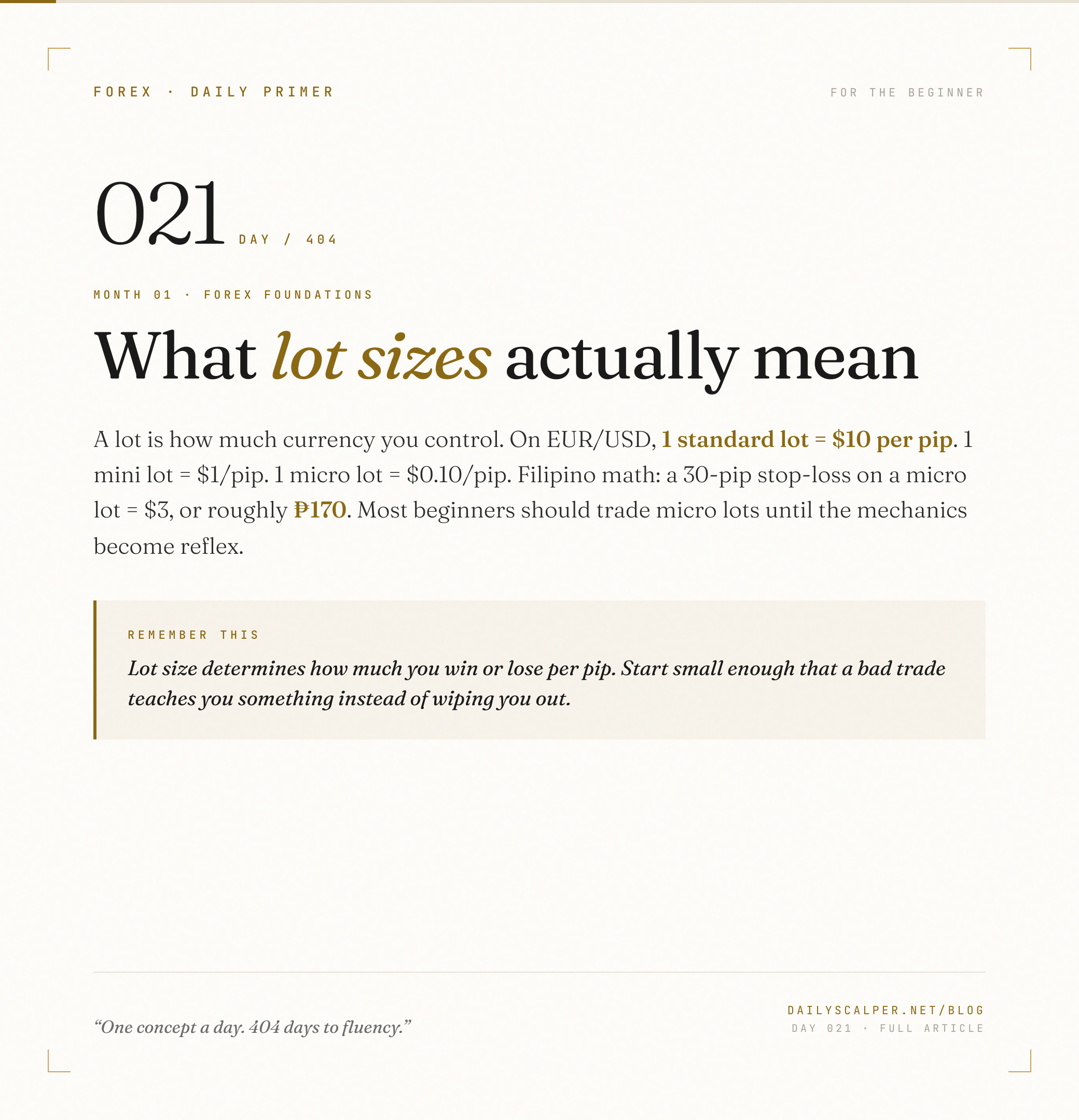
Day 021 / 404 · May 25, 2026
What lot sizes actually mean
A lot is how much currency you control. On EUR/USD, 1 standard lot = $10 per pip. 1 mini lot = $1/pip. 1 micro lot = $0.10/pip. Filipino math: a 30-pi…
-
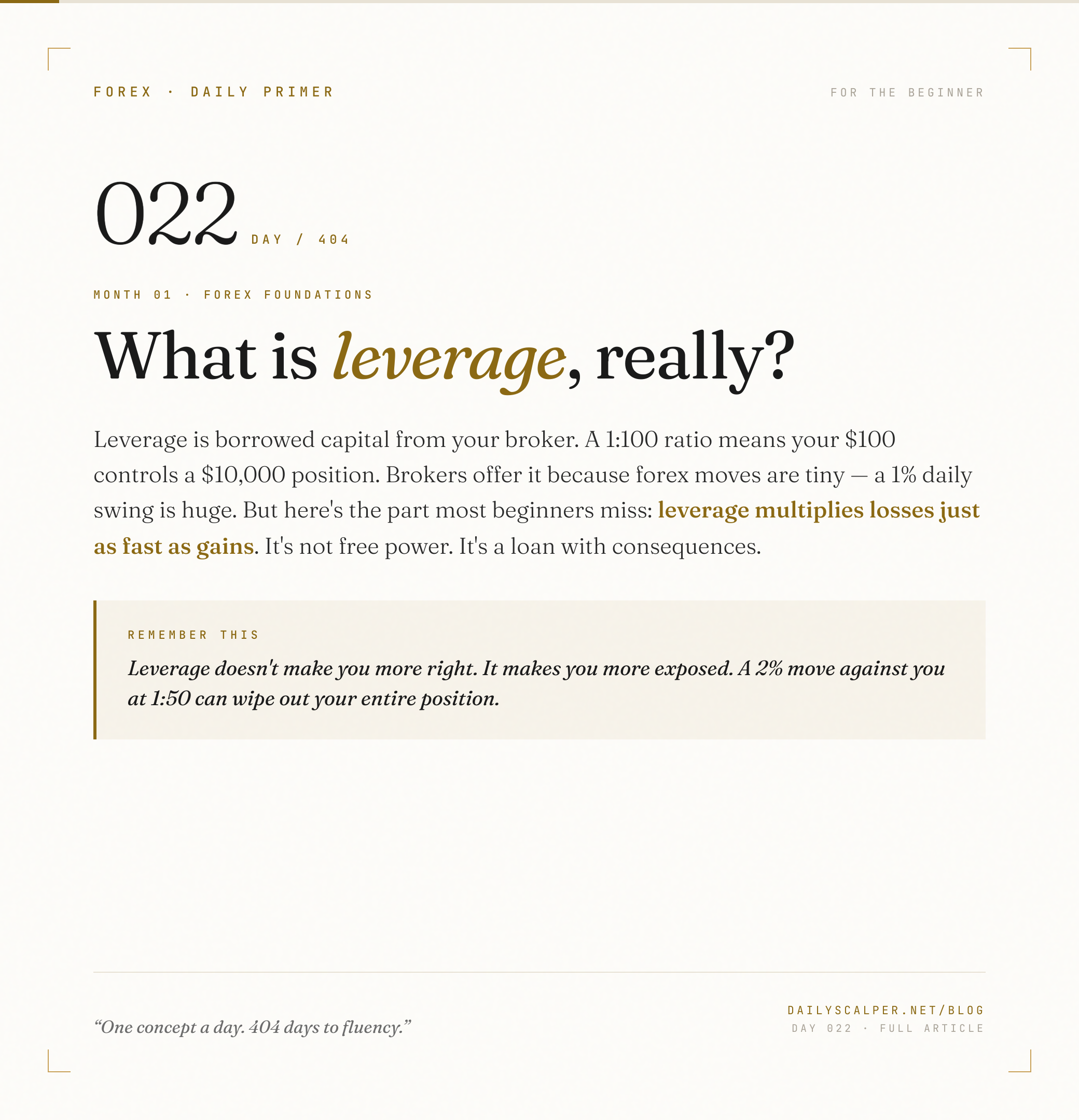
Day 022 / 404 · May 26, 2026
What is leverage, really?
Leverage is borrowed capital from your broker. A 1:100 ratio means your $100 controls a $10,000 position. Brokers offer it because forex moves are tin…
-
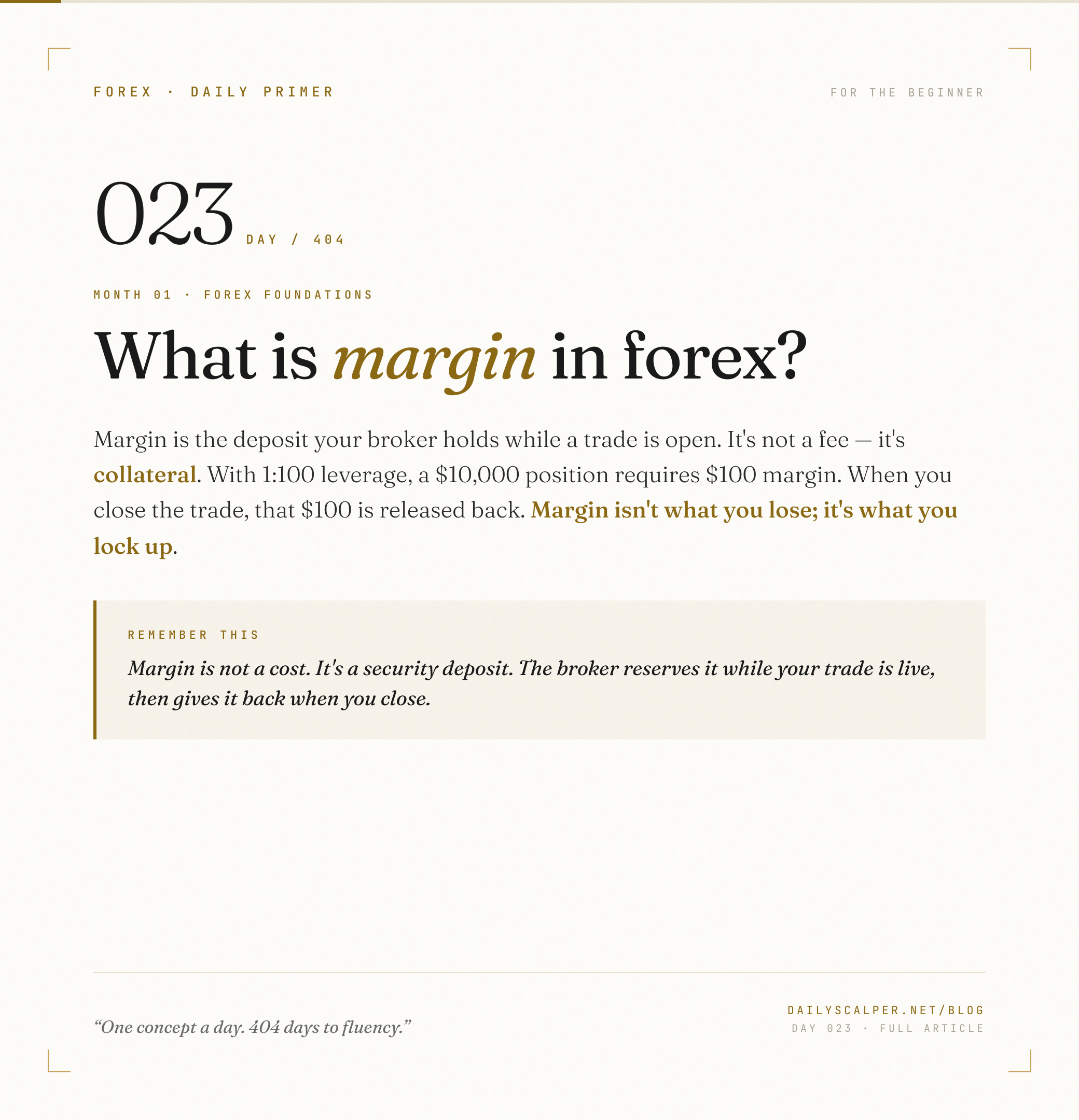
Day 023 / 404 · May 27, 2026
What is margin in forex?
Margin is the deposit your broker holds while a trade is open. It's not a fee — it's collateral. With 1:100 leverage, a $10,000 position requires $100…
-
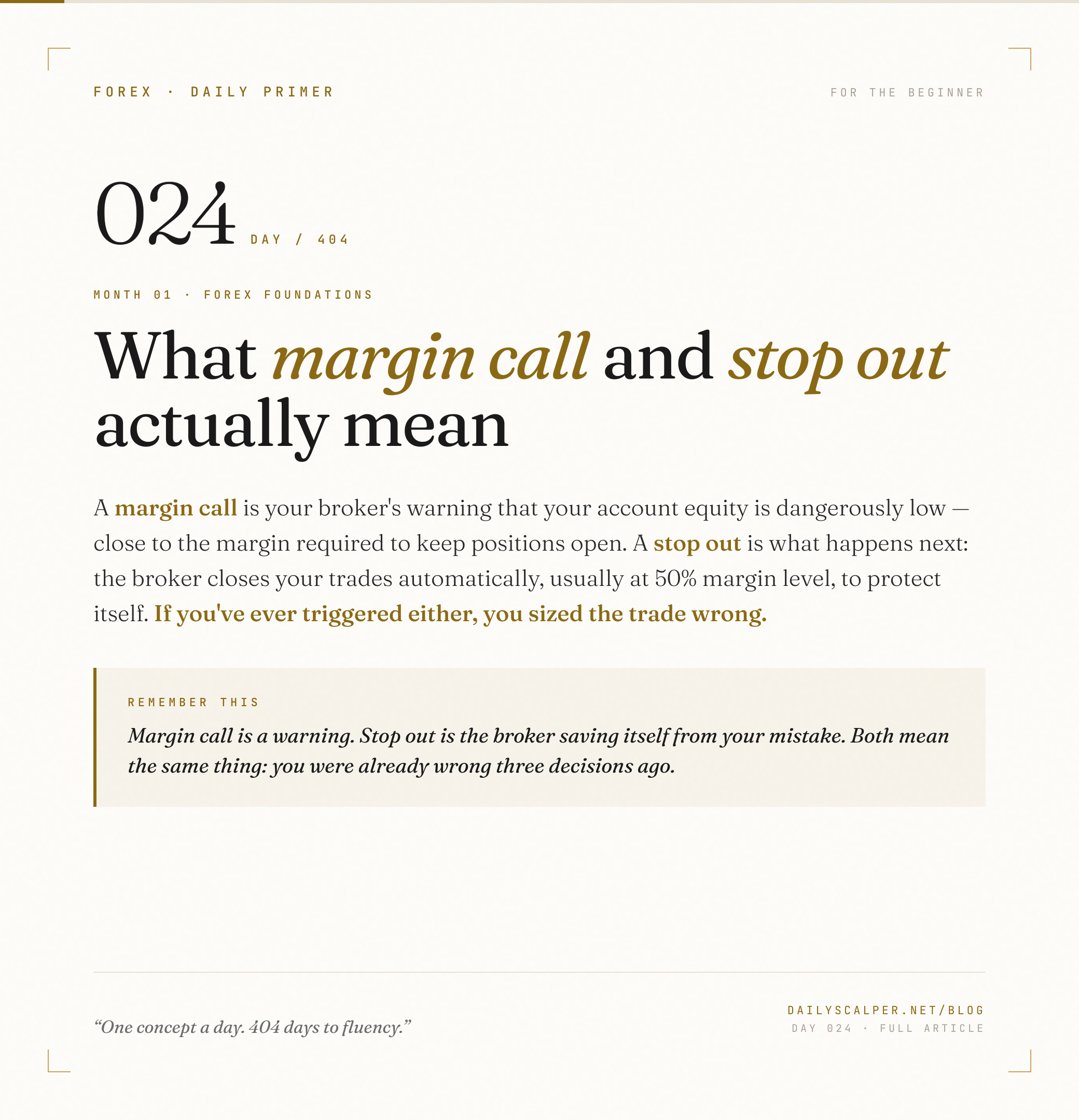
Day 024 / 404 · May 28, 2026
What margin call and stop out actually mean
A margin call is your broker's warning that your account equity is dangerously low — close to the margin required to keep positions open. A stop out i…
-
Day 025 / 404 · May 29, 2026
Reading your broker's status line: Equity, Balance, Free Margin
Your broker shows three numbers at the top of every platform. Balance is your deposit plus or minus closed trades. Equity is balance plus any open pro…
-
Day 026 / 404 · June 1, 2026
What is drawdown, and why it hurts
Drawdown is the percentage your account has fallen from its highest point. If you peak at ₱50,000 and drop to ₱35,000, that's a 30% drawdown. The pain…
-
Day 027 / 404 · June 2, 2026
What is Profit Factor?
Profit factor is gross profit divided by gross loss. A result above 1.0 means your strategy made money. Above 1.5 is solid. Beginners chase high win r…
-
Day 028 / 404 · June 3, 2026
Why keep a trading journal?
A trading journal is not a diary. It's a performance tool. Log every trade: date, pair, direction, entry, stop, target, result, reason, and a screensh…
-
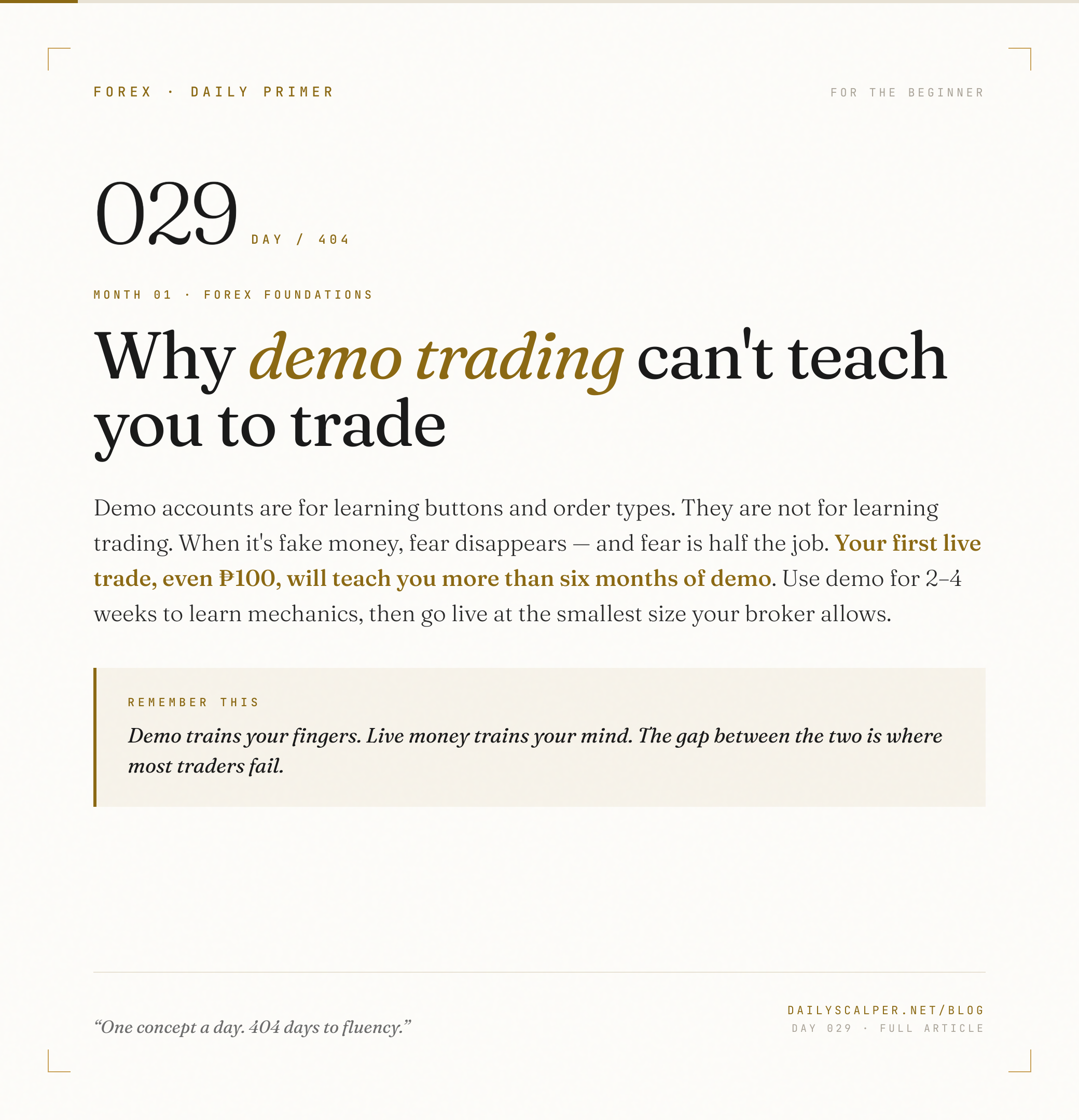
Day 029 / 404 · June 4, 2026
Why demo trading can't teach you to trade
Demo accounts are for learning buttons and order types. They are not for learning trading. When it's fake money, fear disappears — and fear is half th…
-
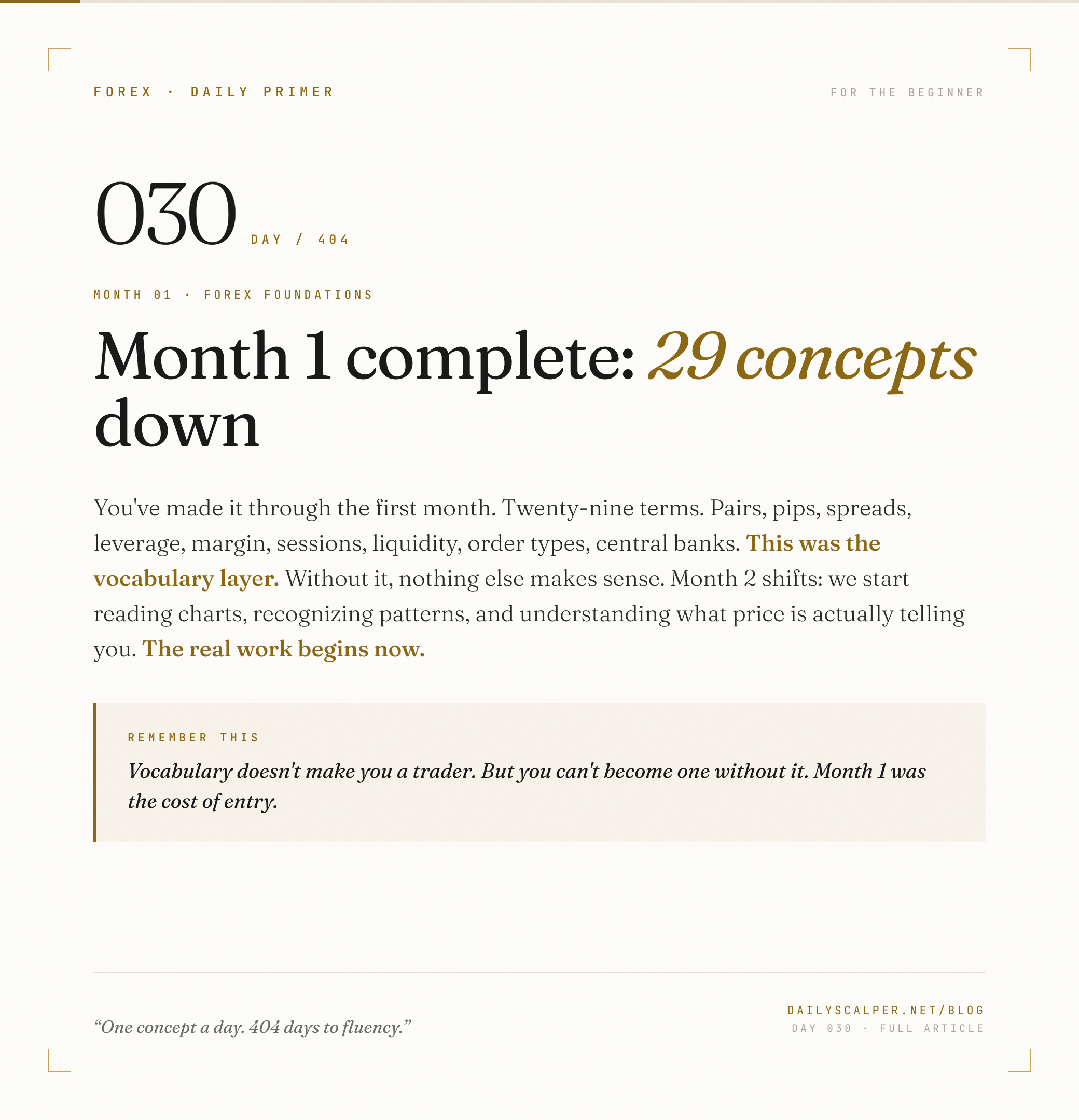
Day 030 / 404 · June 5, 2026
Month 1 complete: 29 concepts down
You've made it through the first month. Twenty-nine terms. Pairs, pips, spreads, leverage, margin, sessions, liquidity, order types, central banks. Th…