What is Forex? A 30-second answer
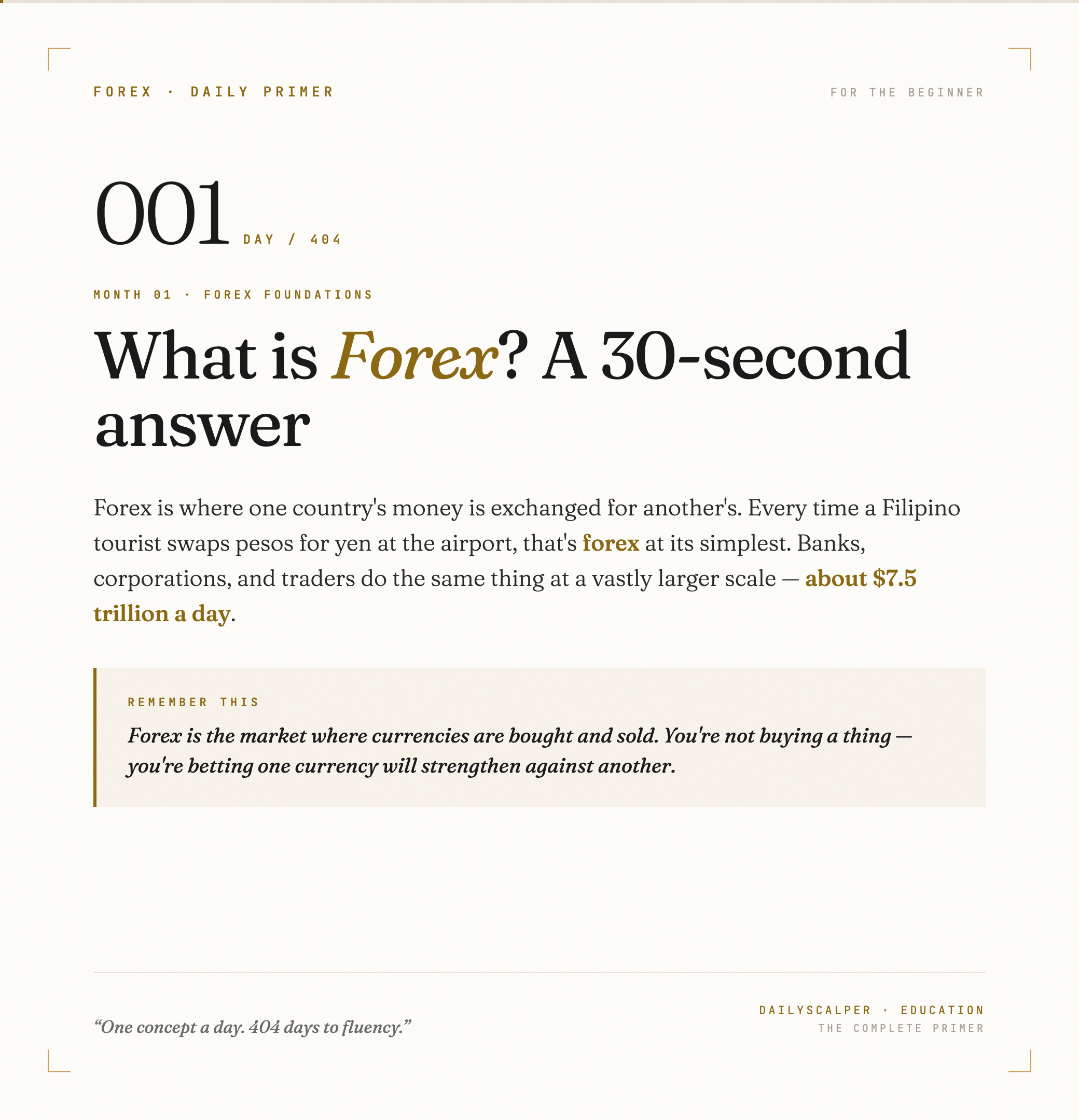
Forex is where one country's money is exchanged for another's. Over the next 404 weekdays, we'll break down everything a beginner needs — one concept at a time, no hype, no shortcuts.
There's a decent chance that the first time you heard the word forex, it came wrapped in some version of “easy money.” This series is the opposite of that. Over 404 weekdays, we'll build up a real working understanding of how currency markets function — one concept per day, starting here.
The 30-second version
Forex (short for foreign exchange) is the global marketplace where one country's currency is traded for another's. When you swap Philippine pesos for Japanese yen before a Tokyo trip, you've done forex. When a multinational company pays a European supplier in euros from a US dollar account, their bank just did forex at a much larger scale. When a trader speculates that the euro will strengthen against the dollar over the next hour, they're doing forex too — just for different reasons.
All three of those activities are part of the same market. That market moves roughly 7.5 trillion US dollars a day — more than every stock exchange in the world combined.
Why the size matters
The sheer volume is what makes forex behave differently from every other market you've heard of. It runs 24 hours a day, Monday through Friday. It has no central exchange — trading happens between banks, brokers, and platforms all over the world. And because of that scale, liquidity is deep: you can buy or sell almost any amount, almost instantly, at a price very close to what everyone else sees.
For a retail trader, this is both good and bad. Good, because you're never stuck holding something you can't exit. Bad, because the same deep liquidity means prices react fast to news, economic data, and central bank decisions — and those reactions don't care whether you're ready.
What you're actually trading
Here's a subtle but important idea: when you trade forex, you're never just buying one currency. You're always trading one against another. The unit is a currency pair — like EUR/USD or USD/JPY — and the price tells you how much of the second currency it takes to buy one unit of the first.
If EUR/USD moves from 1.0800 to 1.0850, the euro has strengthened against the dollar. You didn't “buy euros” — you bet that euros would rise while dollars fell. Every forex position is a relative bet.
We'll unpack currency pairs in detail on Day 3. For now, just hold on to this: you're never betting on one currency in isolation.
What this series will and won't do
This primer covers everything a beginner needs to read charts, understand orders, manage risk, recognise patterns, use indicators sensibly, follow the fundamentals, and build a trading plan that makes sense for your life. It won't promise you profits, it won't share specific buy and sell calls, and it won't pretend the path is easy. Most retail forex traders lose money. A patient, educated one has a meaningfully better chance.
One concept a day. 404 days to fluency. See you tomorrow.
Next: Day 2 — Why does the forex market even exist?