Day 022 / 404 · Forex Foundations · May 26, 2026
What is leverage, really?
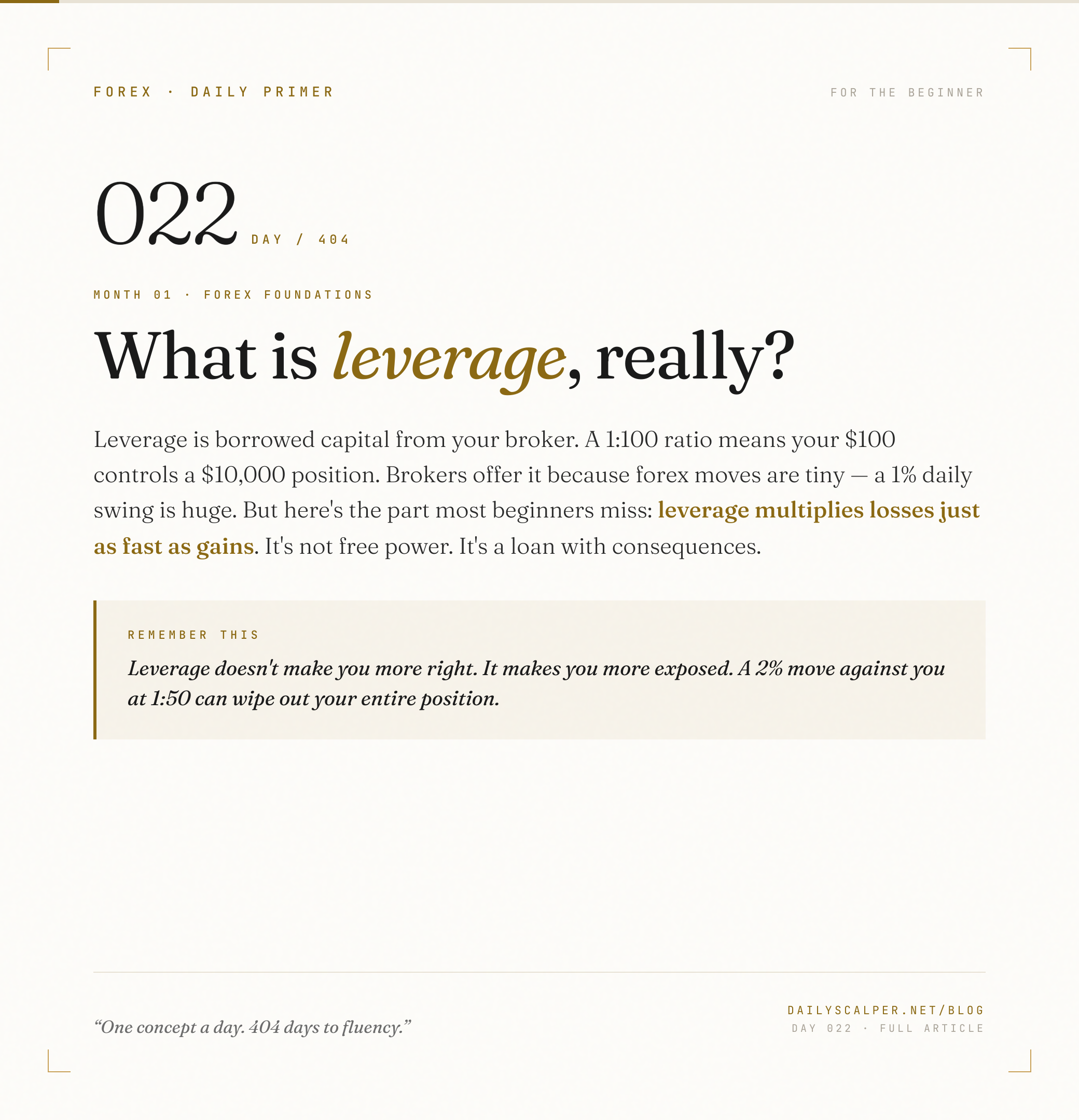
Leverage is borrowed capital from your broker. A 1:100 ratio means your $100 controls a $10,000 position. Brokers offer it because forex moves are tiny — a 1% daily swing is huge. But here's the part
The definition
Leverage is borrowed capital provided by your broker that allows you to control a position larger than the cash you have in your account.
If your broker offers 1:100 leverage, that means every ₱1 you deposit can control ₱100 worth of currency. Put in ₱5,000, and you can open a position worth ₱500,000.
That's not magic. It's a loan. And like any loan, it has consequences.
Why brokers offer it
Forex price moves are small. A 1% move in a single day is considered large. Most pairs move 0.3–0.8% on a normal session.
If you traded ₱10,000 of your own money with no leverage and the pair moved 0.5% in your favor, you'd make ₱50. That's not enough to cover the spread on most trades, let alone make trading worth your time.
Leverage exists to make small percentage moves feel meaningful. It lets retail traders participate in a market originally built for institutions moving millions.
The math everyone skips
Let's say you open a USD/PHP position worth ₱100,000 using 1:100 leverage. You only need ₱1,000 in your account as margin.
- If the pair moves 1% in your favor, you make ₱1,000. You just doubled your money.
- If it moves 1% against you, you lose ₱1,000. Your account is now zero.
Notice the symmetry. Leverage doesn't care which way the market goes. It amplifies both.
A local example
Imagine you're a Makati-based trader with ₱10,000 in your account. You use 1:50 leverage to open a ₱500,000 EUR/USD position.
EUR/USD drops 0.5%. That's a tiny move — barely noticed by institutions. But for you, that's a ₱2,500 loss. Your ₱10,000 account is now ₱7,500.
One more 0.5% move and you're at ₱5,000. Three bad trades in a week, and you're done — not because you're a bad analyst, but because the position size was too large for the capital you had.
Why it's misunderstood
Beginners see leverage as a way to "make more money faster." That's backward.
Leverage is a position-sizing tool. It determines how much market movement your account can survive. Used correctly, it lets you stay small and controlled. Used incorrectly, it turns every trade into a coin flip with your rent money.
The hard truth
Most retail traders don't blow up because they picked the wrong direction. They blow up because they used too much leverage on a trade that was right in theory but hit their stop-loss before the market turned.
The market doesn't care how confident you are. Leverage makes confidence expensive.
What to remember
- Leverage is not optional in forex — even "no leverage" accounts use some, because of how lot sizes work.
- Higher leverage is not a feature. It's a responsibility.
- Your broker will let you use 1:500. That doesn't mean you should.
- Position size matters more than leverage ratio. A small position at 1:100 is safer than a large position at 1:10.