Day 027 / 404 · Forex Foundations · June 2, 2026
What is Profit Factor?
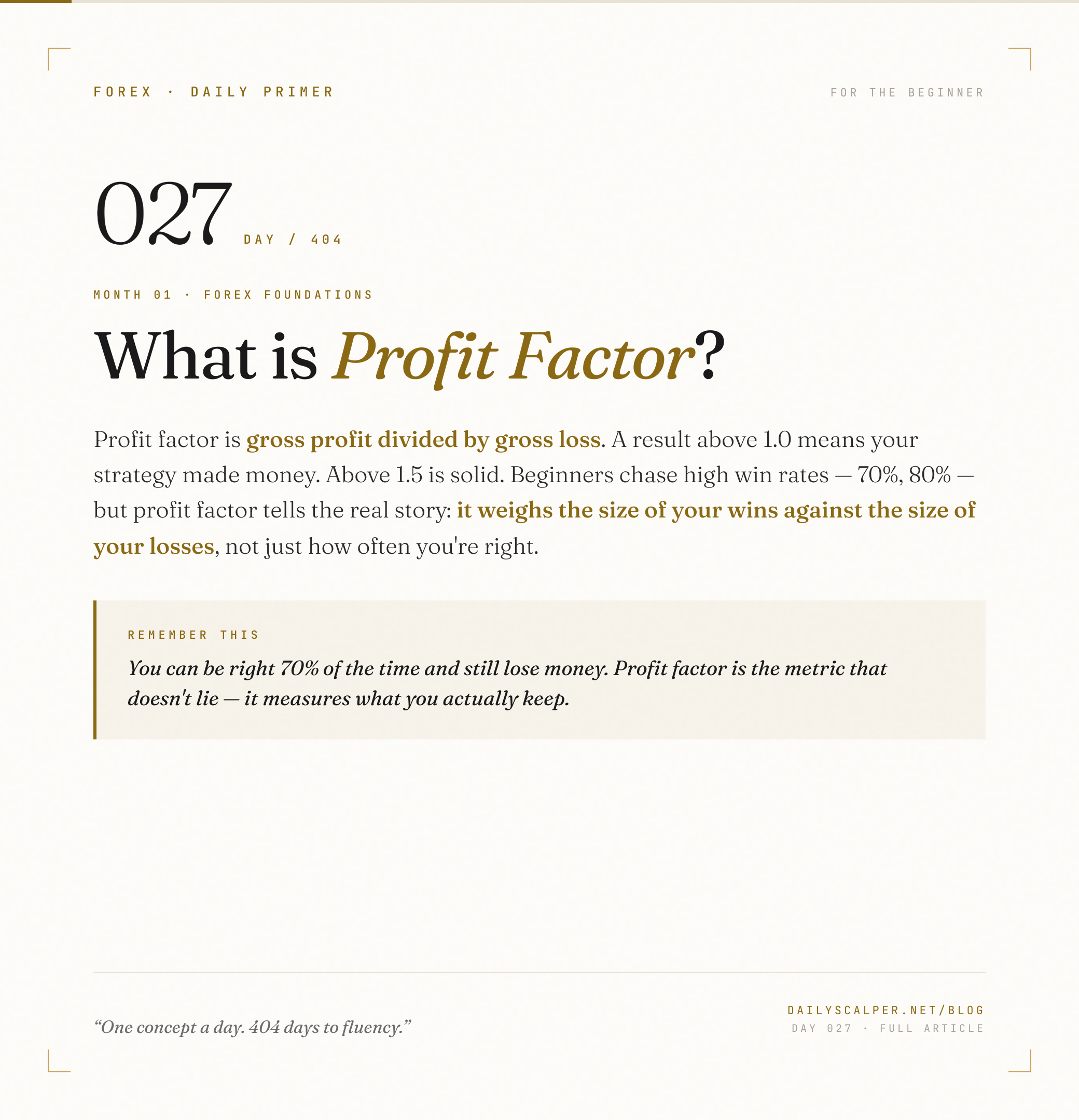
Profit factor is gross profit divided by gross loss. A result above 1.0 means your strategy made money. Above 1.5 is solid. Beginners chase high win rates — 70%, 80% — but profit factor tells the real
The formula
Profit Factor = Gross Profit ÷ Gross Loss
That's it. Add up everything you made on winning trades. Add up everything you lost on losing trades. Divide the first number by the second.
- If the result is greater than 1.0, your strategy made money.
- If it's less than 1.0, you lost money.
- If it's above 1.5, you have a solid edge.
Why beginners get this wrong
New traders love to talk about win rate. "I'm right 75% of the time!" sounds impressive. And it feels good — being right usually does.
But here's the problem: win rate doesn't tell you how much you made when you won or how much you gave back when you lost.
Consider two traders over 10 trades:
Trader A: Wins 7 out of 10. Each win = ₱500. Each loss = ₱2,000. Total profit = ₱3,500. Total loss = ₱6,000. Profit factor = 3,500 ÷ 6,000 = 0.58 Result: Lost money.
Trader B: Wins 4 out of 10. Each win = ₱3,000. Each loss = ₱800. Total profit = ₱12,000. Total loss = ₱4,800. Profit factor = 12,000 ÷ 4,800 = 2.5 Result: Made money.
Trader B was "wrong" more often. Trader B made more money. That's profit factor at work.
A Filipino example
Imagine you're testing a breakout strategy on USD/PHP. Over one month:
- 12 winning trades, total gain: ₱18,000
- 8 losing trades, total loss: ₱10,000
Profit factor = 18,000 ÷ 10,000 = 1.8
That's a strong result. It means for every peso you risk and lose, you're making ₱1.80 back on average. The strategy has an edge — assuming you can keep executing it the same way.
What's a "good" profit factor?
- 1.0–1.25: Barely profitable. Vulnerable to slippage, spread, and mistakes.
- 1.25–1.5: Workable, but needs discipline.
- 1.5–2.0: Solid edge.
- Above 2.0: Rare in real trading. If you see this in a backtest, be skeptical — it probably won't survive live market conditions.
Why it matters more than win rate
Profit factor forces you to think about risk management and reward-to-risk ratio. It doesn't let you hide behind "I'm usually right." It asks the harder question: Are you profitable?
Most retail traders lose money not because they can't pick direction, but because they risk too much on each trade and let losses run. Profit factor exposes that immediately.