Day 011 / 404 · Forex Foundations · May 8, 2026
What is liquidity in forex?
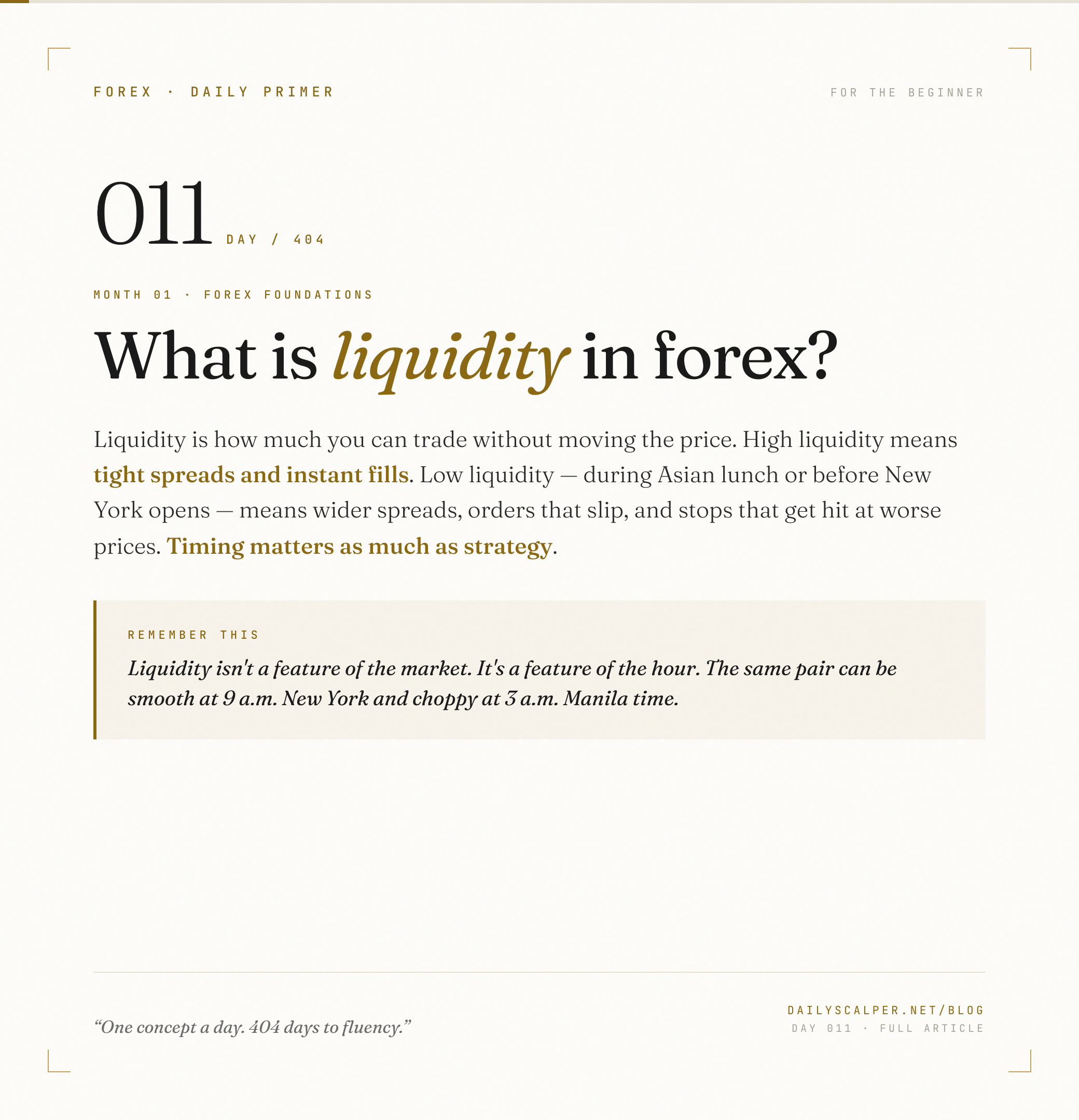
Liquidity is how much you can trade without moving the price. High liquidity means tight spreads and instant fills. Low liquidity — during Asian lunch or before New York opens — means wider spreads, o
What liquidity means
Liquidity is the ability to buy or sell an asset without significantly moving its price. In forex, high liquidity means:
- Tight bid-ask spreads (the gap between the price you can buy and the price you can sell).
- Orders fill instantly at the price you expect.
- Large positions can enter or exit without slippage.
Low liquidity is the reverse: spreads widen, fills are unpredictable, and even a modest trade can push the price against you.
Why liquidity changes by the hour
Forex runs 24 hours, but not all hours are equal. Liquidity depends on who is awake and trading.
High liquidity windows:
- London session open (3:00 p.m. to midnight Manila time) — European banks, hedge funds, and corporates are active.
- New York overlap with London (8:00 p.m. to midnight Manila time) — the busiest four hours of the day. EUR/USD, GBP/USD, and USD/JPY spreads are at their tightest.
Low liquidity windows:
- Asian lunch (roughly 12:00 p.m. to 2:00 p.m. Manila time) — Tokyo traders step away. Spreads widen.
- Pre-New York, post-Tokyo close (5:00 a.m. to 8:00 a.m. Manila time) — the market drifts. Price can whipsaw on thin volume.
- Sunday evening (as the market opens) — liquidity is thin until Tokyo ramps up.
If you're day trading from Manila, this matters. A strategy that works beautifully at 9:00 p.m. (New York morning) may bleed money at 6:00 a.m.
Real-world example: GCash remittance and USD/PHP liquidity
Imagine you're a freelancer receiving USD payments and converting to pesos via your bank or an app. You'll notice the exchange rate is slightly worse than the "market rate" you see on Google. Part of that gap is the spread — and spreads are wider on USD/PHP than on major pairs like EUR/USD, because USD/PHP has lower liquidity.
Now imagine trading USD/PHP as a retail forex position at 3:00 a.m. Manila time. Liquidity is even thinner. Your 10,000-unit order might move the price by several pips. Your stop-loss, set at 56.75, gets filled at 56.78 because there weren't enough orders sitting at 56.75.
That's slippage. And slippage is a tax on low-liquidity trades.
When to avoid trading
You don't need to trade every hour the market is open. In fact, you shouldn't.
Avoid:
- Major pairs during Asian lunch if you're scalping tight ranges.
- Exotic or minor pairs outside their regional session (e.g., USD/ZAR at 2:00 a.m. Johannesburg time).
- The first 10–15 minutes after major news releases, when liquidity vanishes and spreads spike.
- Sunday evening opens, unless you have a specific reason.
Liquidity is invisible until it's not
Most beginners don't notice liquidity — until a stop-loss gets hit five pips away from where it was set, or a limit order never fills even though price "touched" the level on the chart.
That's low liquidity at work. The market didn't cheat you. You traded at the wrong time.