Day 013 / 404 · Forex Foundations · May 13, 2026
ECN vs Market Maker: what's the difference?
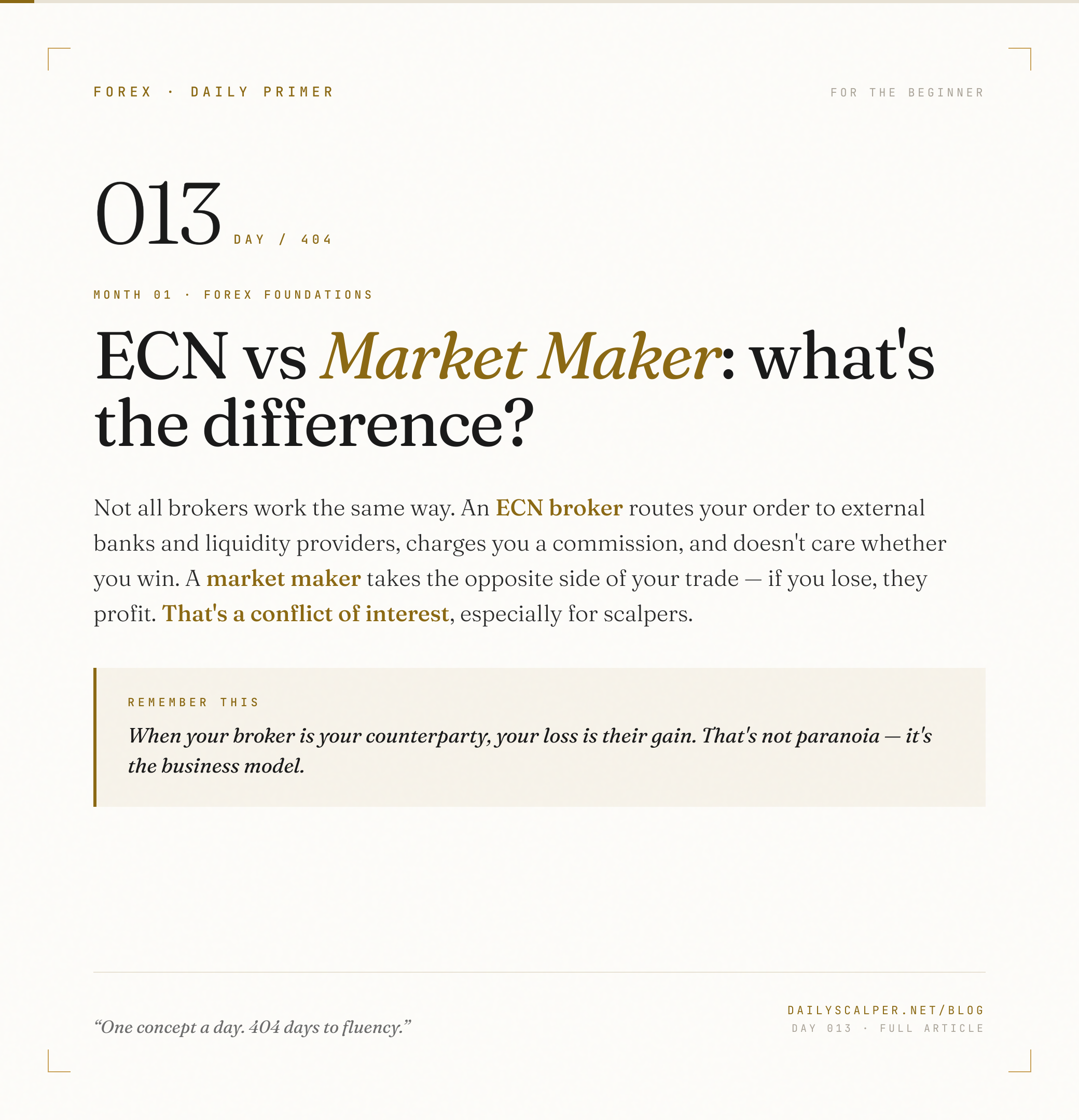
Not all brokers work the same way. An ECN broker routes your order to external banks and liquidity providers, charges you a commission, and doesn't care whether you win. A market maker takes the oppos
Two ways brokers make money
When you open a forex trade, someone has to be on the other side. The question is: who?
The answer determines how your broker makes money — and whether their incentives align with yours.
There are two dominant models in retail forex: ECN/STP brokers and market makers. They look similar on the surface. They are not.
ECN and STP brokers
ECN stands for Electronic Communication Network. STP means Straight-Through Processing. In practice, both terms describe brokers that route your order to external liquidity providers — banks, hedge funds, other traders.
Here's what happens when you place a buy order on EUR/USD with an ECN broker:
1. Your order is sent to a pool of liquidity providers. 2. The best available price is matched. 3. You pay a commission — usually $3 to $7 per standard lot, round-turn. 4. The broker earns that commission whether you win or lose.
Notice the last point. The broker has no financial interest in the outcome of your trade. You are not their counterparty.
Market makers
A market maker broker takes the opposite side of your trade. When you buy, they sell to you. When you sell, they buy from you.
They don't charge commission. Instead, they widen the spread slightly and pocket the difference. More importantly: if you lose, they keep your money. If you win, they pay you out of their own pocket — unless they hedge your trade externally, which cuts into their margin.
This creates a structural conflict of interest.
Why it matters for scalpers
If you're trading once a week and holding for days, broker type might not make much difference. But if you're a scalper — entering and exiting multiple times a day, targeting 5–15 pips — execution quality is everything.
Market makers have been known to:
- Requote prices during fast markets
- Widen spreads when you're in profit
- Reject or delay orders from consistently winning accounts
Not all market makers do this. But the incentive is baked into the model.
### A Filipino example
Imagine you're a consistent scalper in Makati. You make 15 trades a week, average 8 pips profit per trade. Over two months, your account is up 18%. Then your broker — a market maker — starts widening your EUR/USD spread from 1.2 pips to 2.8 pips, but only on your account. Your edge evaporates.
That's not paranoia. It's happened to enough traders that the pattern is well documented.
With an ECN broker, your success costs them nothing. You pay the same commission whether you win ₱500 or lose ₱5,000.
How to tell which model your broker uses
Check these signs:
- Commission charged per trade? Likely ECN/STP.
- "Zero commissions" but wider spreads? Likely market maker.
- Variable spreads that widen during news? Could be either, but ECN brokers show raw spreads from the market.
- Fixed spreads no matter what? Almost certainly market maker.
Most brokers will state their model in fine print, but marketing language can be vague. Look for phrases like "A-book" (ECN) vs "B-book" (market maker).
Which should you choose?
If you're learning and trading small size, a market maker might be fine — lower minimum deposits, simpler fee structure.
If you plan to scalp, trade frequently, or grow past beginner size, an ECN broker will save you money and frustration in the long run.
Your broker's job is to give you access to the market — not to bet against you.