Day 006 / 404 · Forex Foundations · April 30, 2026
What is a pipette?
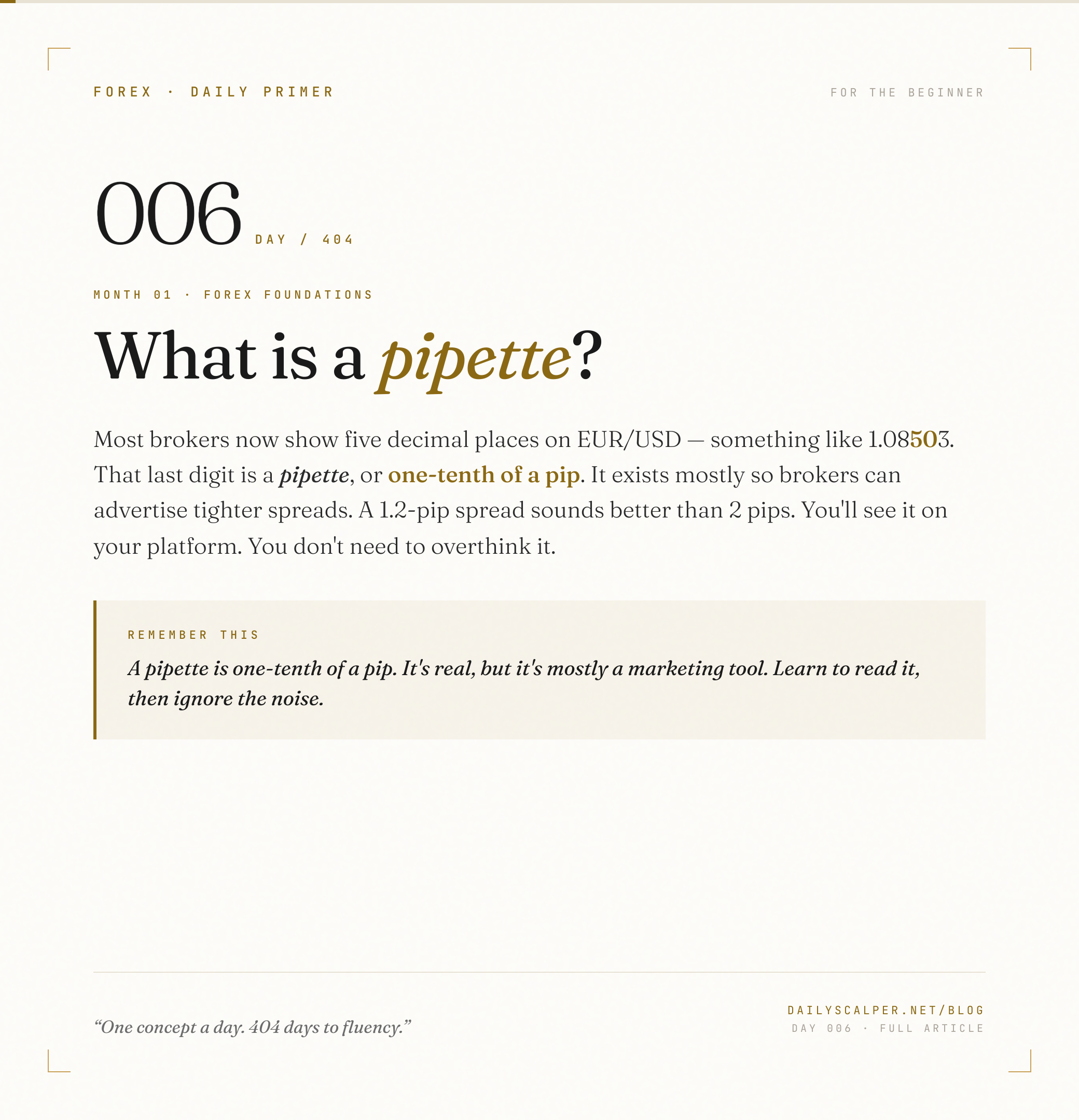
Most brokers now show five decimal places on EUR/USD — something like 1.08503. That last digit is a pipette, or one-tenth of a pip. It exists mostly so brokers can advertise tighter spreads. A 1.2-pip
What you see on the screen
Open any retail forex platform today and look at a EUR/USD quote. You'll probably see something like:
1.08503
Five decimal places. The convention used to be four. The fifth digit — the 3 in this example — is called a pipette, or a fractional pip. It represents one-tenth of a pip.
If the price moves from 1.08503 to 1.08504, that's a one-pipette move. Ten pipettes equal one pip.
Why brokers added it
The short answer: marketing.
When brokers compete on spread — the difference between the buy and sell price — fractions matter. A broker that can advertise "0.8 pips on EUR/USD" sounds tighter than one advertising "1 pip," even if the real cost difference to you is a few pesos per lot.
Pipettes let brokers split hairs. They're not dishonest, but they do let the numbers look better in ads.
Where you'll see pipettes (and where you won't)
Most major pairs now show five decimals: EUR/USD, GBP/USD, AUD/USD.
Yen pairs show three decimals instead of two. USD/JPY might quote at 150.123. The third decimal — the 3 — is the pipette.
Your broker's order entry, your stop-loss, your take-profit — most of these still work in full pips by default. Some platforms let you set fractional pip levels, but it's rare that retail traders need that precision.
A practical example
You're trading EUR/USD. Your entry is 1.08500. Your stop-loss is 20 pips away at 1.08300. The quote ticks to 1.08503.
That three-pipette move is real, but it's 0.3 pips — not enough to change your risk math, not enough to adjust your position. You note it, then move on.
The takeaway for Filipino traders
If you're calculating position size in pesos, or setting a stop based on your GCash deposit, pipettes won't change your math. A 20-pip stop is still a 20-pip stop, whether the platform shows 1.08500 or 1.085003.
Learn to read the fifth decimal so you're not confused when you see it. Then let it fade into the background. The pip is still your working unit.