Day 014 / 404 · Forex Foundations · May 14, 2026
Why regulation matters more than you think
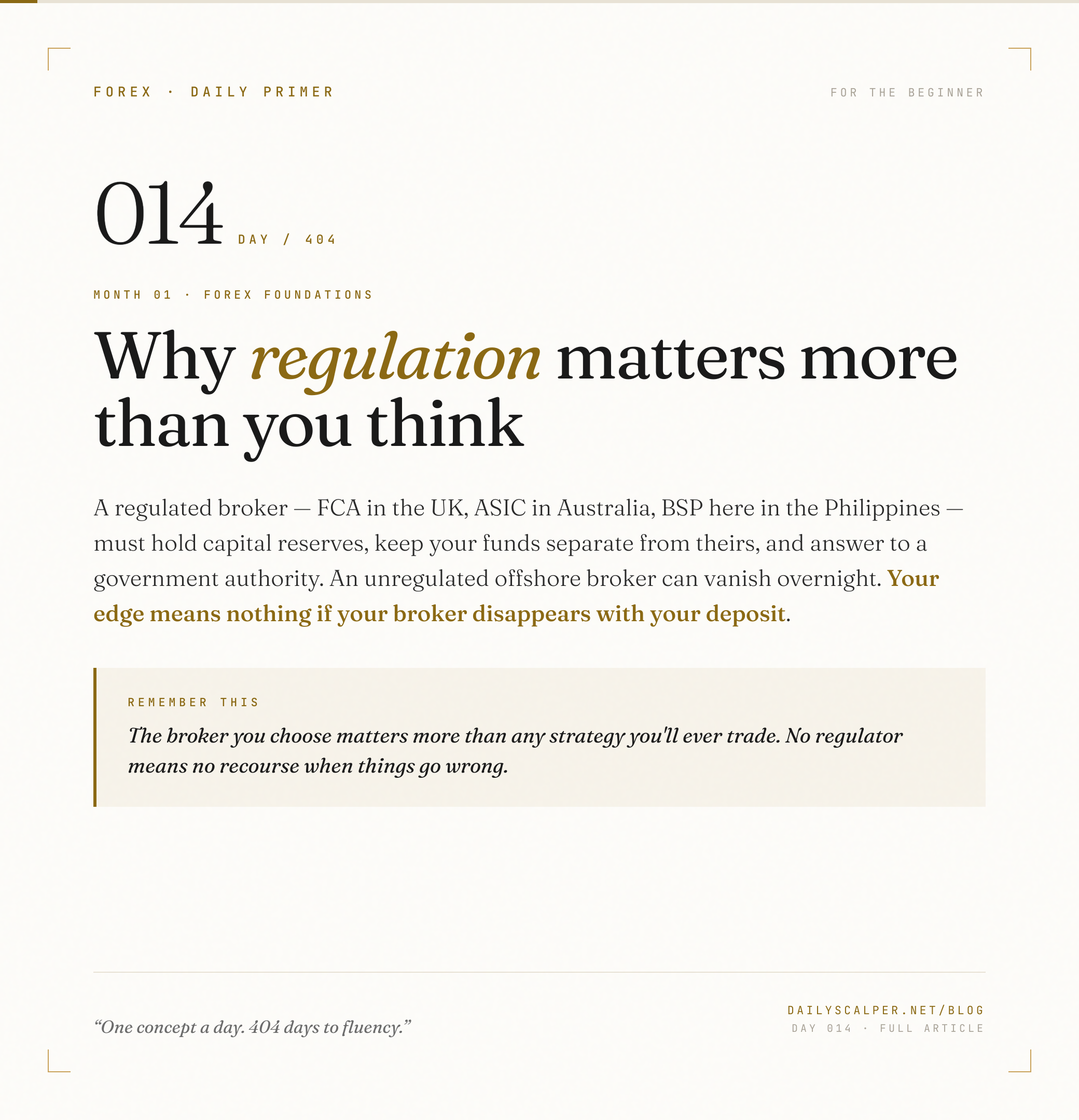
A regulated broker — FCA in the UK, ASIC in Australia, BSP here in the Philippines — must hold capital reserves, keep your funds separate from theirs, and answer to a government authority. An unregula
The unsexy truth
Regulation is boring. It doesn't show up in YouTube thumbnails. It won't improve your win rate. But it's the single most important filter you can apply when choosing where to put your money.
Here's why.
What regulation actually does
When a broker is regulated by a recognized authority — the Financial Conduct Authority (FCA) in the UK, the Australian Securities and Investments Commission (ASIC), the Cyprus Securities and Exchange Commission (CySEC), or the Bangko Sentral ng Pilipinas (BSP) — they are required by law to:
- Hold minimum capital reserves. They can't operate on fumes. If they go under, there's a buffer.
- Segregate client funds. Your deposit sits in a separate account, not mixed with the broker's operating cash. If the company collapses, your money is ringfenced.
- Submit to regular audits. Regulators check the books. Brokers can't cook the numbers indefinitely.
- Offer dispute resolution. If something goes wrong — a withdrawal is blocked, a trade is misquoted — you have a formal channel to escalate.
None of this guarantees you'll make money. It guarantees the game isn't rigged from the start.
What happens without regulation
Offshore brokers — registered in jurisdictions with no real oversight — often advertise better conditions: tighter spreads, higher leverage, faster execution. Some are legitimate. Many are not.
The problem is simple: no regulator means no recourse.
If an unregulated broker decides not to process your withdrawal, you have no one to call. No ombudsman. No government body. You're done.
This has happened to Filipino traders more times than anyone wants to count. A broker offers 1:1000 leverage and a $10 minimum deposit. You fund the account via a payment processor you've never heard of. You make a few good trades. Then you try to withdraw, and the broker goes silent. Or the website goes down. Or they ask for "verification documents" that never get approved.
You just donated your money.
A local example
The BSP doesn't regulate many forex brokers directly yet, but they do regulate banks and remittance channels that brokers use to move peso deposits. If a broker operating in the Philippines is working through a BSP-supervised bank, that's a meaningful data point. It means they're not operating in total shadow.
Compare that to a broker with a Seychelles license and a Gmail support address.
The trade-off is real
Regulated brokers cost more to run. That cost gets passed to you in the form of slightly wider spreads or lower maximum leverage. If you're in the EU, for example, retail leverage is capped at 1:30 under ESMA rules.
That feels restrictive — until you remember that most traders who blow up do so because of high leverage, not in spite of it.
The bottom line
Your broker is the infrastructure. You can have the best strategy, the cleanest discipline, and a 70% win rate — but if your broker disappears, you have nothing.
Check the regulator. Google the license number. Make sure the website of the regulator lists that broker by name. It takes five minutes and might save you everything.