Day 004 / 404 · Forex Foundations · April 28, 2026
The three tiers: Majors, Minors, Exotics
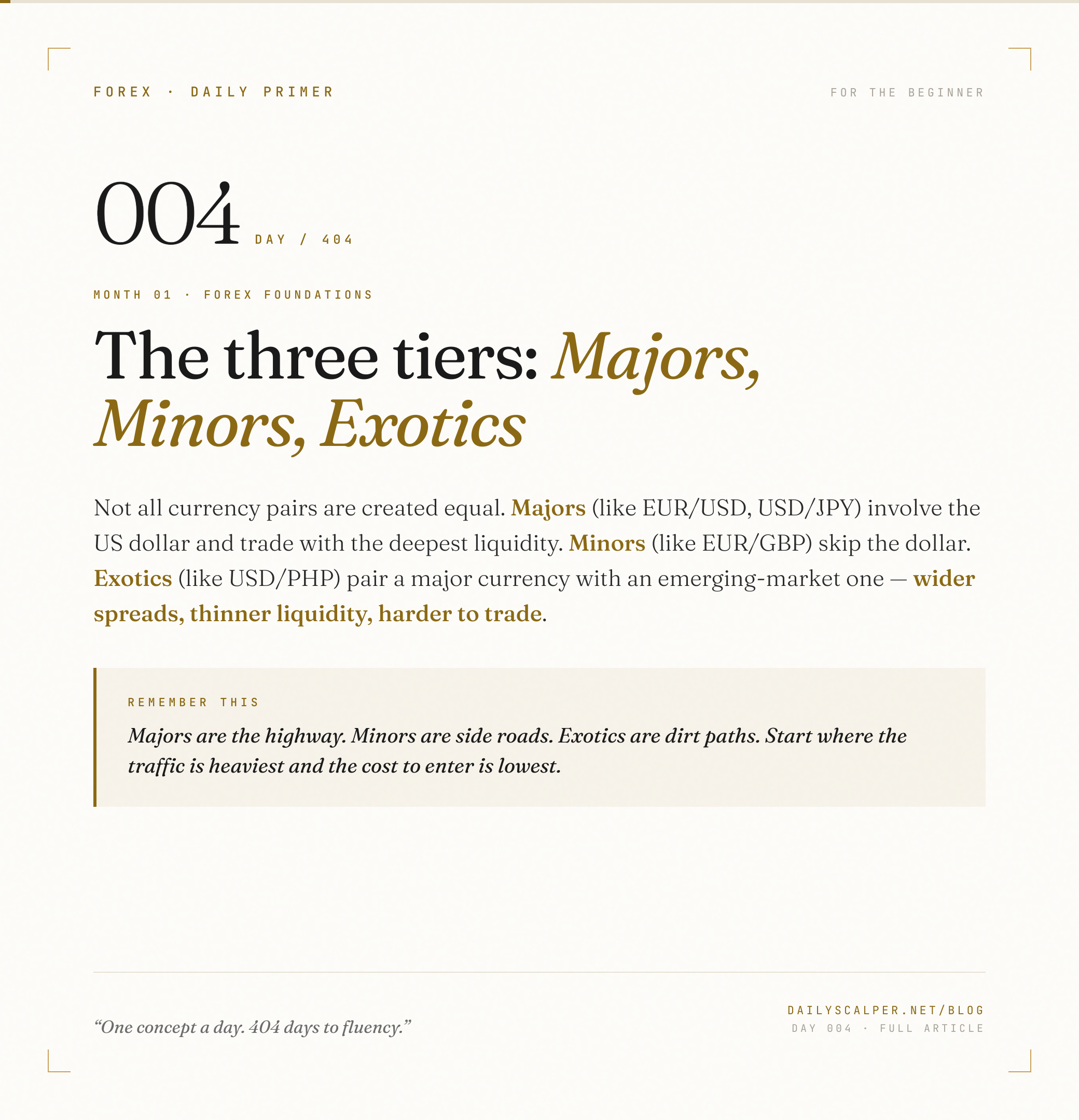
Not all currency pairs are created equal. Majors (like EUR/USD, USD/JPY) involve the US dollar and trade with the deepest liquidity. Minors (like EUR/GBP) skip the dollar. Exotics (like USD/PHP) pair
The three-tier system
Forex pairs aren't a flat list. The market organizes them by liquidity, spread cost, and how much real commercial flow they carry. Understanding the tiers helps you choose where to focus your attention — and where to stay away until you know what you're doing.
Majors: the core seven or eight
The major pairs all include the US dollar on one side. They are:
- EUR/USD (euro / US dollar)
- GBP/USD (British pound / US dollar)
- USD/JPY (US dollar / Japanese yen)
- USD/CHF (US dollar / Swiss franc)
- AUD/USD (Australian dollar / US dollar)
- USD/CAD (US dollar / Canadian dollar)
- NZD/USD (New Zealand dollar / US dollar)
Some lists add EUR/JPY or treat it as a minor. The boundary isn't sacred. What matters: these pairs have the tightest spreads, the deepest liquidity, and the most predictable behavior. When news breaks, majors react first and cleanest.
Minors: cross-pairs without the dollar
Minor pairs (also called cross-pairs) skip the US dollar entirely. Examples:
- EUR/GBP
- EUR/AUD
- GBP/JPY
They're still liquid enough for retail traders, but spreads are wider than majors. Price action can be choppier because these pairs are often synthetic — your broker is crossing two major pairs behind the scenes to give you the quote.
Exotics: emerging markets and wider spreads
Exotic pairs involve one major currency and one from a smaller or emerging-market economy. Examples:
- USD/PHP (US dollar / Philippine peso)
- USD/THB (US dollar / Thai baht)
- EUR/TRY (euro / Turkish lira)
- USD/ZAR (US dollar / South African rand)
Exotics have wider spreads — sometimes 10 to 50 pips or more. Liquidity is thinner. That means slippage: your order might fill several pips away from where you clicked. It also means overnight swaps (rollover interest) can be large and unpredictable, especially if the emerging-market central bank is hiking or cutting rates aggressively.
Why beginners should start with majors
If you're learning to trade, the majors give you the cleanest feedback loop. Tighter spreads mean each trade costs you less to enter. Higher liquidity means your stop-loss and take-profit orders are more likely to execute where you set them. Price movements on majors are driven by widely reported economic data — US jobs numbers, European Central Bank meetings, Bank of Japan policy — so you're learning to read the same headlines everyone else watches.
Exotics look tempting if you're Filipino and want to trade the peso. But USD/PHP is expensive to trade, and its moves are often driven by BSP intervention or thin overnight sessions where a single large order can spike the price.
Learn on EUR/USD. Once you're consistently disciplined there, branch out.