Day 005 / 404 · Forex Foundations · April 29, 2026
What is a pip?
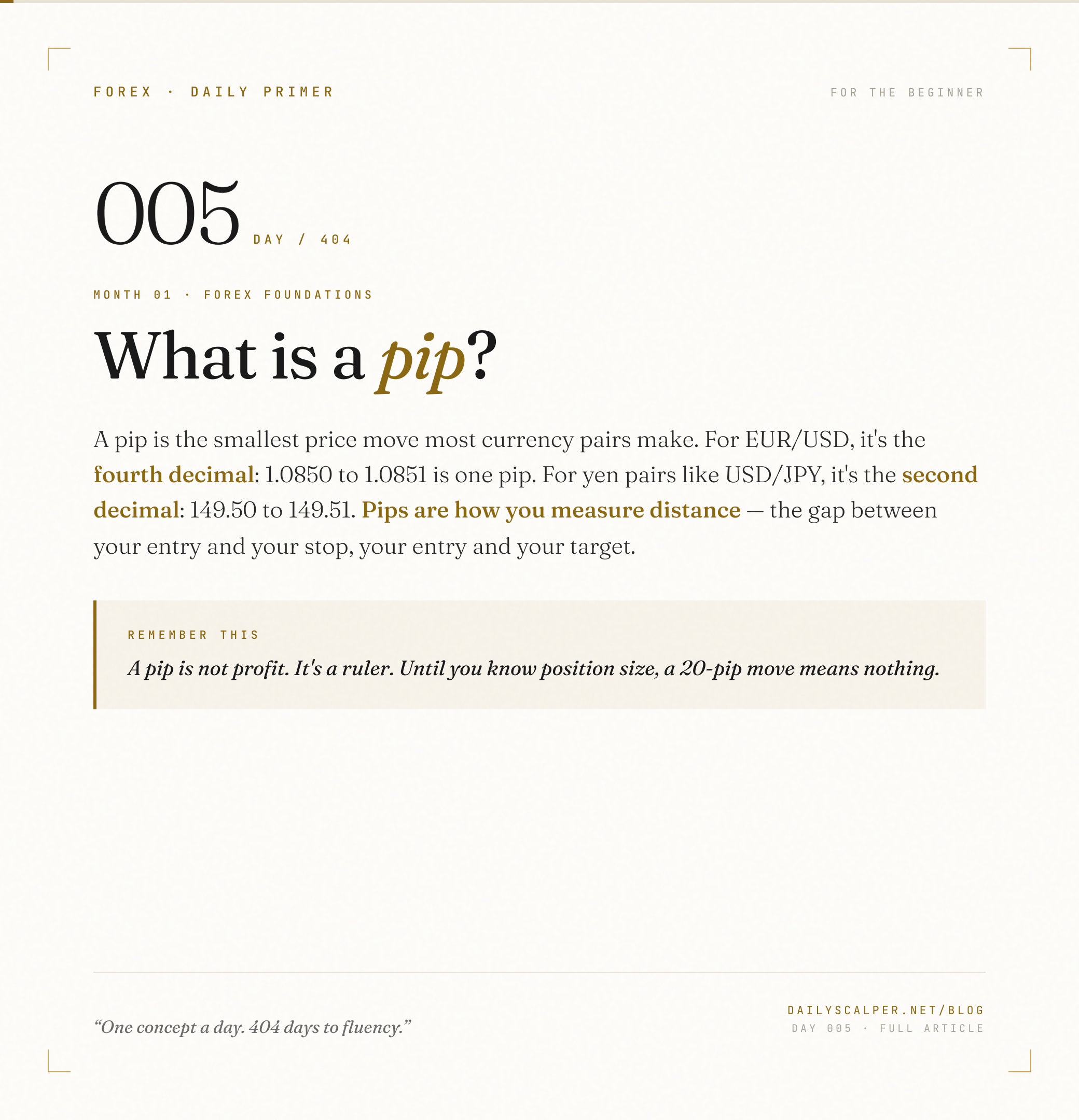
A pip is the smallest price move most currency pairs make. For EUR/USD, it's the fourth decimal: 1.0850 to 1.0851 is one pip. For yen pairs like USD/JPY, it's the second decimal: 149.50 to 149.51. Pip
The definition
A pip stands for "percentage in point" or "price interest point," depending on who you ask. In practice, it's simpler: it's the smallest standardized price move in a currency pair.
For most pairs — EUR/USD, GBP/USD, AUD/USD — a pip is the fourth decimal place:
- EUR/USD moves from 1.0850 to 1.0851 → that's 1 pip.
- GBP/USD moves from 1.2700 to 1.2650 → that's 50 pips down.
For yen pairs — USD/JPY, EUR/JPY — a pip is the second decimal place, because yen quotes are much larger numbers:
- USD/JPY moves from 149.50 to 149.51 → 1 pip.
- USD/JPY moves from 150.00 to 149.20 → 80 pips down.
You'll also see a fifth decimal on most broker platforms (like 1.08503). That's called a pipette or fractional pip. Ignore it for now.
Why pips matter
Pips are your ruler. They let you measure three things:
1. Distance to your stop loss. If you buy EUR/USD at 1.0850 and set your stop at 1.0830, that's 20 pips of risk. 2. Distance to your target. If your target is 1.0900, that's 50 pips of potential reward. 3. How the market moved. "EUR/USD dropped 40 pips after the Fed statement" tells you scale, independent of account size.
Notice what's missing: money. A pip by itself has no peso value. That depends on your position size, which we'll cover soon.
A Filipino example: connecting pips to pesos
Let's say you open a 0.01 lot position on EUR/USD (that's a micro lot — the smallest size many brokers allow). On that size, one pip is worth roughly $0.10, or about ₱5.50 at current exchange rates.
If you risk 20 pips with a stop loss, you're risking around ₱110. If you gain 50 pips, you make about ₱275.
Scale that up to 0.10 lots (a mini lot), and one pip becomes ₱55. Same 20-pip stop, but now it's ₱1,100 at risk.
The pip count stays the same. The money changes with position size. This is why beginners who jump straight to "how much can I make?" without understanding pips usually get hurt — they don't know what they're actually risking.
What to remember
A pip is a unit of measurement, not a unit of profit. It's the difference between two prices. You'll use it every single day you trade, so get comfortable with the idea now: fourth decimal for most pairs, second decimal for yen.