Day 016 / 404 · Forex Foundations · May 18, 2026
How brokers charge: commissions vs spreads
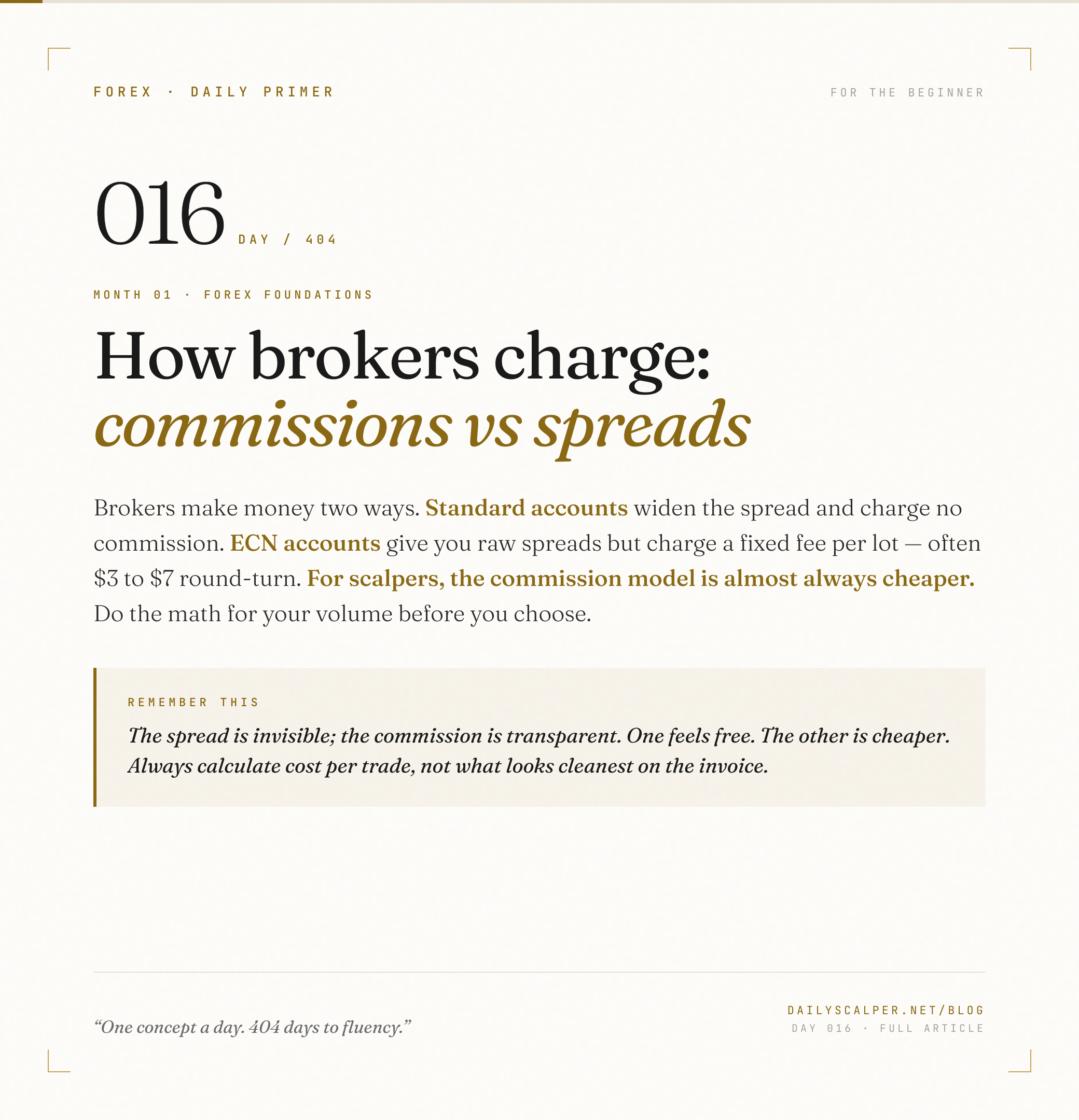
Brokers make money two ways. Standard accounts widen the spread and charge no commission. ECN accounts give you raw spreads but charge a fixed fee per lot — often $3 to $7 round-turn. For scalpers, th
Two ways brokers get paid
Every forex broker needs to make money. There are no free lunches. The question is how they charge you, and whether that structure matches the way you intend to trade.
There are two dominant models:
### 1. Standard (or market-maker) accounts
You see a spread — the difference between the buy price and the sell price. That spread is wider than the "raw" interbank spread. The broker keeps the difference. You pay no explicit commission. Your statement looks clean.
Example: EUR/USD might show a 1.5-pip spread. If the interbank spread is 0.2 pips, the broker's cut is roughly 1.3 pips per side.
### 2. ECN (or raw-spread) accounts
You see the tight interbank spread — sometimes as low as 0.0 to 0.3 pips on major pairs. But the broker charges a commission per lot traded, often $3 to $7 round-turn (open + close).
Example: You trade one standard lot of EUR/USD. Spread cost: 0.2 pips = $2. Commission: $6. Total cost: $8.
Which is cheaper?
It depends on three things:
- How often you trade. If you open two trades a month, a couple of extra pips won't hurt. If you scalp ten times a day, every fractional pip compounds.
- How many pips you're targeting. A 50-pip swing trade can absorb a 1.5-pip spread. A 5-pip scalp cannot.
- Your position size. Commissions are fixed per lot. Spreads scale with size, but the percentage cost changes depending on how long you hold.
### A quick comparison (EUR/USD, 1 standard lot)
| Account type | Spread | Commission | Total cost | |--------------|--------|------------|------------| | Standard | 1.5 pips | $0 | $15 | | ECN | 0.2 pips | $6 | $8 |
For a scalper trying to grab 5–8 pips, that $7 difference per trade is the difference between profit and loss.
The Philippine context
Many brokers serving Filipinos offer both account types. When you're comparing, convert commission to pesos at current rates and compare against the pip cost in your typical trade size.
If you're funding with GCash or a local bank transfer and your broker charges in USD, factor in the conversion spread too — that's another hidden cost.
The psychological difference
Standard accounts feel cheaper because there's no line item. ECN accounts make the cost explicit. Humans hate seeing fees. But explicit is better. You can measure it, track it, and optimize around it.