Day 023 / 404 · Forex Foundations · May 27, 2026
What is margin in forex?
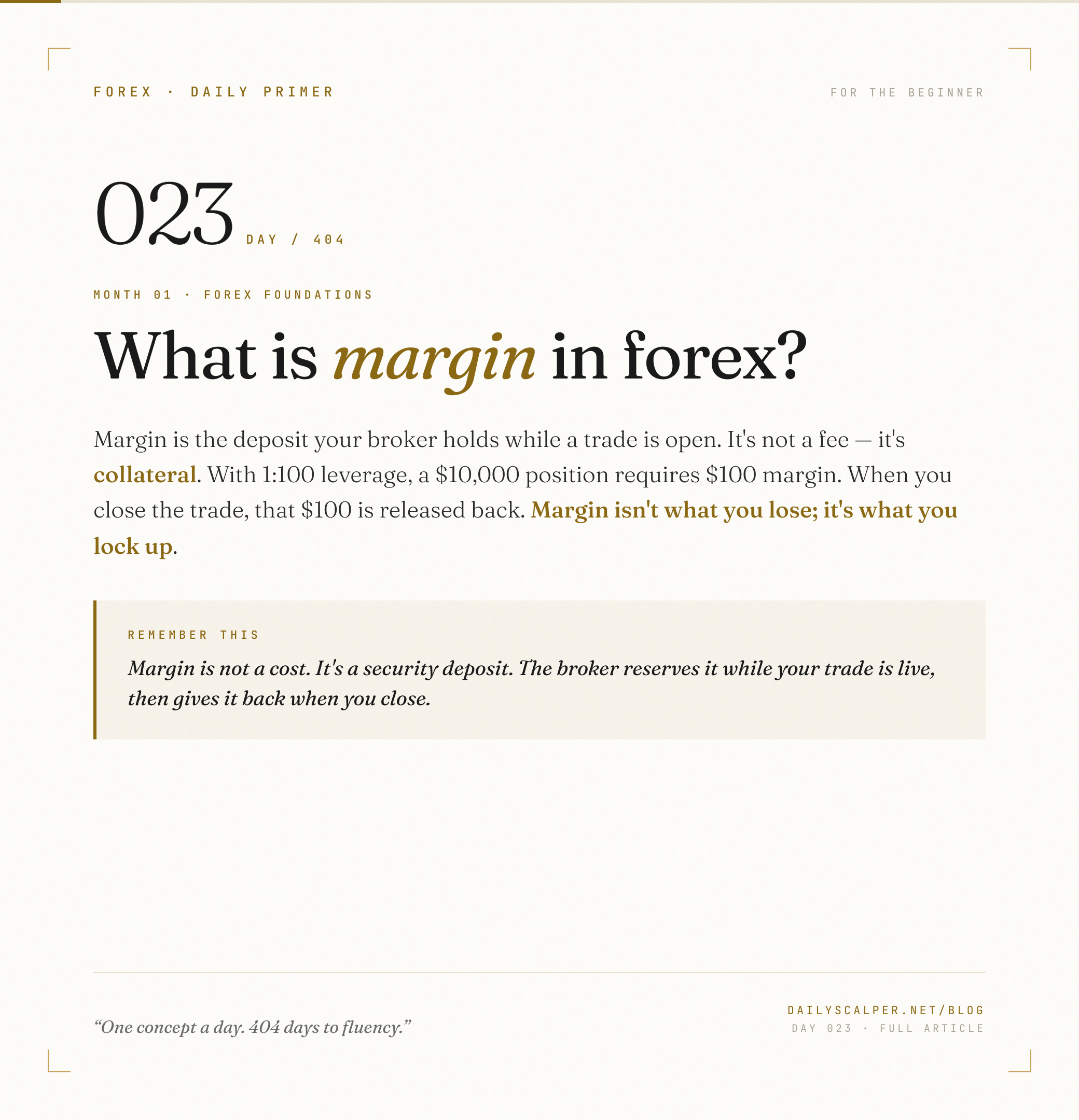
Margin is the deposit your broker holds while a trade is open. It's not a fee — it's collateral. With 1:100 leverage, a $10,000 position requires $100 margin. When you close the trade, that $100 is re
The confusion around margin
Ask a new trader what margin is, and you'll hear guesses: "It's a fee," "It's what you lose when the trade goes bad," "It's the broker's cut." None of those are right.
Margin is simpler than it sounds. It's the collateral your broker holds while a leveraged trade is open. Think of it as a security deposit — like what you pay when you rent an apartment. When you move out (close the trade), you get it back.
How margin works in practice
Let's say you want to open a position worth $10,000 in EUR/USD. Your broker offers 1:100 leverage. That means you only need to put up 1% of the position size as margin.
1% of $10,000 = $100 margin required.
Your broker locks that $100 from your account balance. It's still yours — it's just reserved. You can't use it to open another trade until this one closes.
When you close the position, win or lose, that $100 is released back into your available balance.
Margin is not a fee
This is the key insight. The broker does not take your margin. It doesn't disappear. It's temporarily set aside.
What you actually lose (or gain) is determined by how the market moves and where you close the trade. That profit or loss is separate from margin.
A Filipino example
Imagine you're a freelancer who uses GCash. A client asks you to hold ₱5,000 in your wallet as a "good faith deposit" while a project is ongoing. You still own that ₱5,000 — you just can't spend it until the project ends. When it's done, the hold is lifted.
Margin works the same way. Your broker holds a slice of your balance while the trade is live, then releases it when you're out.
Why brokers require margin
Leverage lets you control a large position with a small account. But leverage also means risk. If the trade moves against you, the broker needs assurance that you can cover potential losses.
Margin is that assurance. It's the broker's way of saying, "You can borrow our capital to amplify your trade, but we're holding collateral in case things go wrong."
What happens if margin runs low
If your trade moves against you and your account equity drops, your free margin (the amount available for new trades) shrinks. If it drops too far, you hit a margin call — a warning that you're close to not having enough collateral to keep your positions open.
We'll cover margin calls in detail later. For now, just understand: margin is what you reserve. Equity is what you have left after accounting for open profit or loss.
The takeaway
Margin is not mysterious. It's not a hidden cost. It's a deposit that gets returned when the trade closes.
Most retail traders lose money not because they don't understand margin, but because they open positions so large that a small move wipes out their equity. Margin is the mechanic. Position sizing is the decision that matters.