Day 012 / 404 · Forex Foundations · May 12, 2026
What is a forex broker?
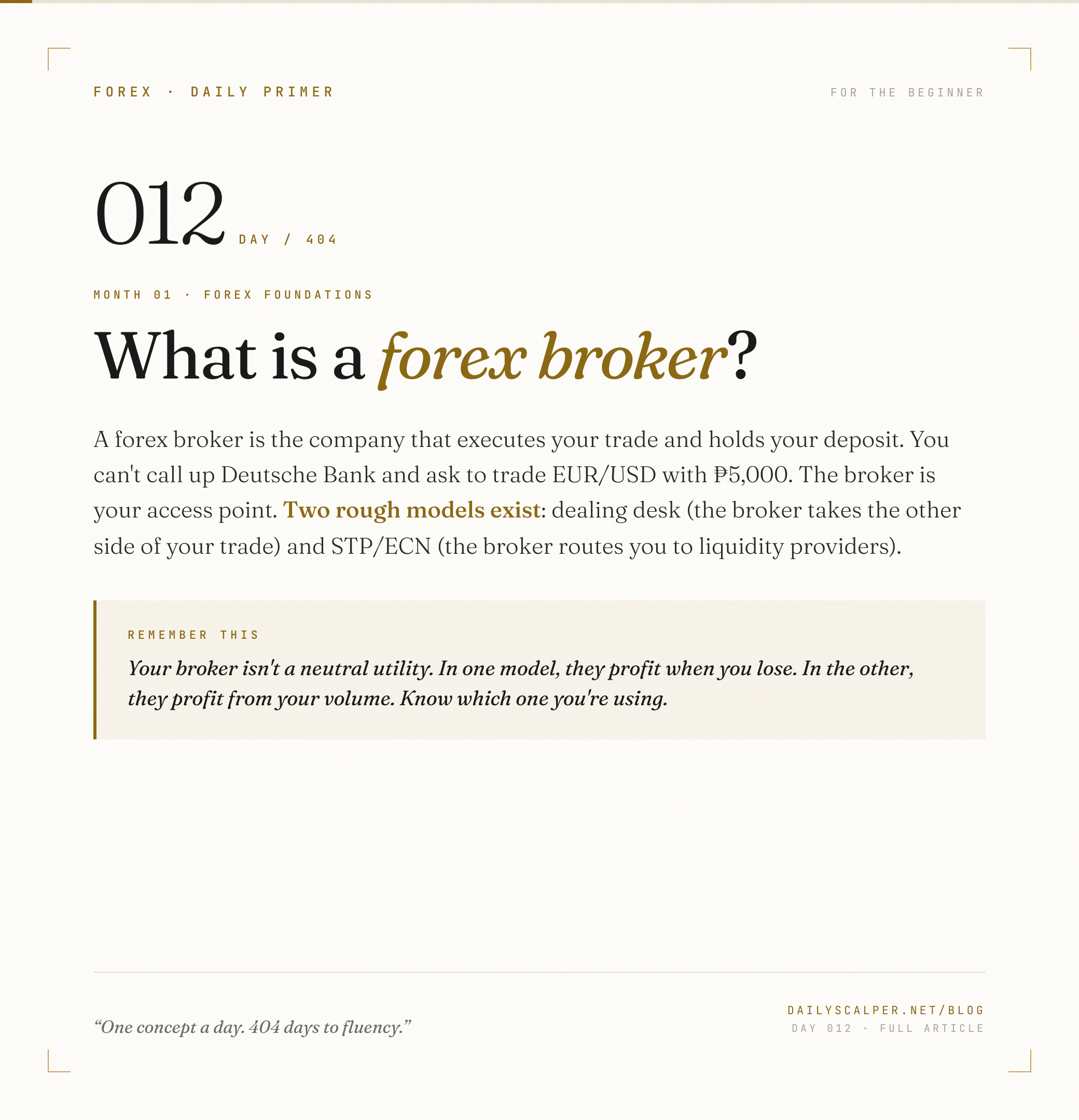
A forex broker is the company that executes your trade and holds your deposit. You can't call up Deutsche Bank and ask to trade EUR/USD with ₱5,000. The broker is your access point. Two rough models e
Why you need a broker
Retail traders can't access the interbank forex market directly. You're not going to call up HSBC or JPMorgan and ask to trade 0.01 lots of GBP/USD with ₱5,000. That's where a forex broker comes in: they aggregate liquidity, provide a trading platform, hold your deposit as margin, and execute your orders.
In short, the broker is your access point to the market.
Two rough models
Not all brokers operate the same way. The difference comes down to what happens after you click buy or sell.
### Dealing Desk (Market Maker)
In this model, the broker takes the opposite side of your trade. If you buy EUR/USD, the broker sells it to you — from their own book. They may hedge some of that risk by offsetting with other clients or taking positions in the interbank market, but they don't have to.
This creates an obvious conflict of interest: your loss is their gain. If you lose ₱10,000, the broker keeps it (minus any hedging costs). If you win ₱10,000, the broker pays you out of their pocket.
Not all dealing-desk brokers are predatory. Many are regulated and operate transparently. But the incentive structure is worth understanding.
### STP / ECN
Straight-Through Processing (STP) and Electronic Communication Network (ECN) brokers route your order to a pool of liquidity providers — banks, hedge funds, other brokers. You're trading against that pool, not against the broker.
The broker earns money from spreads (a small markup on the price) or a commission per trade. Whether you win or lose doesn't affect their revenue. They profit from your volume, not your losses.
This model tends to offer tighter spreads, faster execution, and less conflict of interest — but it often requires higher minimum deposits and charges explicit commissions.
A Filipino scenario
Imagine you're an OFW in Dubai. You open an account with a dealing-desk broker offering ₱500 minimum deposit and no commissions. It looks friendly. But when you start winning consistently, you notice slippage, requotes, or sudden spread widening during volatile hours.
Now imagine the same trader with an STP broker. Minimum deposit is ₱5,000, and you pay $3.50 per standard lot. But your orders fill fast, spreads stay tight, and the broker doesn't care whether you win — they already earned their commission.
Neither is automatically better. It depends on your capital, your strategy, and how much you trust the counterparty.
What to ask
Before you deposit:
- Does the broker take the other side of my trade, or route it to liquidity providers?
- How do they make money — spreads, commissions, or both?
- Are they regulated by a credible authority (ASIC, FCA, CySEC)?
- What happens to my deposit if the broker goes under?
Most retail traders pick a broker based on signup bonuses or flashy ads. That's backward. Start with the business model.